
New Zealand arrival declaration
NZTD vs NZeTA vs IVL: The Three That Get Confused
A clear breakdown of the three New Zealand requirements travellers mix up: the free NZTD declaration, the paid NZeTA authority, and the IVL tourism levy.
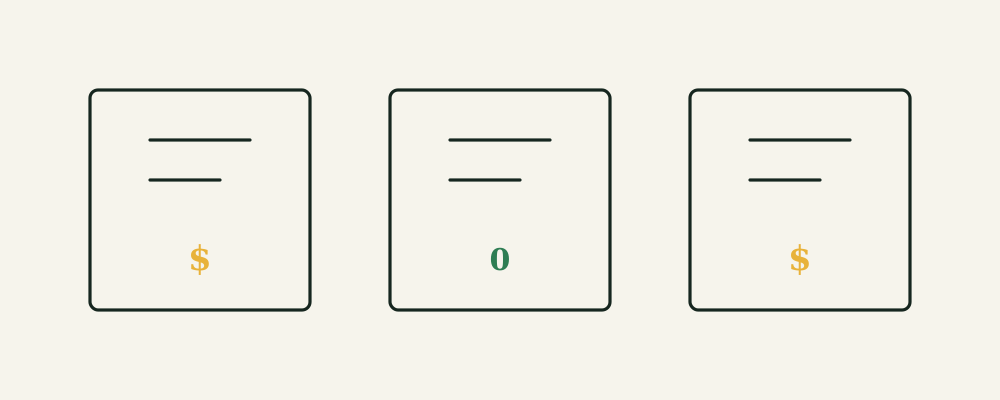
Three sets of letters cause more confusion about New Zealand than anything else: NZTD, NZeTA and IVL. They sound similar, they all involve a government website, and travellers routinely assume that doing one means the others are covered. They are not. They are three separate things, with different purposes, different costs and different timing, and getting them straight is the single best way to avoid a nasty surprise at the border.
In brief: The NZTD is a free arrival declaration everyone completes just before travelling. The NZeTA is a paid travel authority some nationalities need, valid around two years and arranged in advance. The IVL is a conservation and tourism levy of about NZD 100, usually paid with the NZeTA or visa. One never replaces another.
Why these three get muddled
The confusion is understandable. All three are digital, all three are linked to your passport, and all three appear when you search for how to enter New Zealand. Travel forums make it worse by using the abbreviations loosely, as if they were interchangeable.
But they answer different questions. The NZeTA and visa answer "are you allowed to travel to New Zealand?" The IVL answers "have you paid the visitor levy?" The NZTD answers "what are you bringing, and where have you been?" Three questions, three requirements. Clearing up which is which saves money, time and stress.
In short: the three overlap in your mind but not in their purpose, and each one has to be handled on its own.
The NZTD in one paragraph
The New Zealand Traveller Declaration (NZTD) is a free, mandatory digital declaration that every traveller completes before arriving, including New Zealand passport holders, babies and children, one per person. It replaced the old paper arrival card and gathers travel, customs, immigration and biosecurity information. You submit it in the short window just before you travel: from 24 hours before your journey and before you reach passport control. It is tied to your passport and checked automatically at the eGate or by an officer.
The key point for this guide: the NZTD is about your arrival details, not your permission to enter. It does not, on its own, let anyone into the country. If your nationality needs a NZeTA or a visa, the NZTD does not stand in for either.
In short: the NZTD is the free arrival declaration everyone does at the last minute; it records your trip, it does not grant entry.
The NZeTA in one paragraph
The New Zealand Electronic Travel Authority (NZeTA) is a paid pre-travel authorisation. It is required by travellers from visa-waiver countries and by many people transiting through Auckland. It is requested in advance, typically valid for around two years or until your passport expires, and it can cover multiple trips within that period. Unlike the NZTD, it is genuinely something to sort out early, weeks before you fly.
The NZeTA is your permission side of the equation for visa-waiver nationalities. If you come from a country that is not visa-waiver, you generally need a visa instead, arranged through Immigration NZ. Either way, that permission is separate from, and earlier than, the NZTD.
Good to know: Whether you need a NZeTA, a visa, or neither depends entirely on your nationality and purpose of travel. Check your specific situation on the official channels rather than assuming.
In short: the NZeTA is the paid, plan-ahead authority for visa-waiver travellers and certain transits, valid for about two years.
The IVL in one paragraph
The International Visitor Conservation and Tourism Levy (IVL) is a levy, currently around NZD 100 per person, that helps fund conservation and tourism infrastructure. It is not a separate application you fill in. Instead, you usually pay it together with your NZeTA or your visa, so for most visa-waiver travellers it is simply an extra charge that appears during the NZeTA process.
Some travellers are exempt from the IVL, and the amount can change, so treat the figure as a guide rather than a fixed number. What matters is understanding that the levy is a cost, bundled with your entry permission, and completely separate from the free NZTD.
In short: the IVL is a tourism levy of about NZD 100, paid alongside your NZeTA or visa, not a form of its own.
Side-by-side comparison
The table lines up the three so the differences are obvious. Figures are current guides, not fixed amounts, so always confirm on the official site.
| Feature | NZTD | NZeTA | IVL |
|---|---|---|---|
| What it is | Arrival declaration | Travel authority | Tourism and conservation levy |
| Cost | Free | Paid (a request fee) | About NZD 100 per person |
| Who needs it | Everyone arriving | Visa-waiver nationals and many transits | Most visitors, paid with the NZeTA or visa |
| When to do it | Just before travel, within 24 hours | Well in advance | At the same time as the NZeTA or visa |
| Validity | Single arrival | Around 2 years | Tied to your visit |
| Grants entry? | No | Yes, for eligible nationalities | No, it is a charge |
| Where | Official site or NZTD app | Official NZeTA channel | Bundled with the NZeTA or visa |
In short: free versus paid, everyone versus some, last-minute versus planned ahead. The table is the whole story.
Who needs each one
Your combination depends on your nationality and plans. A few common profiles make it concrete:
- A visa-waiver visitor (for example from Spain, Germany or the UK): needs a NZeTA (paid, in advance), pays the IVL with it, and completes the NZTD just before flying.
- An Australian citizen: does not need a NZeTA to visit, but still completes the NZTD on every arrival.
- A traveller from a country that requires a visa: arranges a visa through Immigration NZ, with the IVL typically handled in that process, and still completes the NZTD.
- A transit passenger through Auckland: may need a NZeTA for transit, and completes the NZTD only if actually entering New Zealand.
The single constant across almost every profile is the NZTD: nearly everyone who arrives completes it. What varies is the permission layer above it.
In short: the NZTD is close to universal; the NZeTA, visa and IVL depend on your nationality and purpose.
A quick glossary of the three
If the acronyms blur together, this plain-language glossary keeps them apart:
- NZTD — New Zealand Traveller Declaration. A free digital form about your arrival: your travel, customs, immigration and biosecurity details. Everyone completes it, just before travelling.
- NZeTA — New Zealand Electronic Travel Authority. A paid authorisation to travel, for visa-waiver nationals and certain transits. Arranged in advance, valid around two years.
- IVL — International Visitor Conservation and Tourism Levy. A levy of about NZD 100, paid with the NZeTA or visa, funding conservation and tourism.
Notice the pattern: one is a declaration, one is an authority, one is a levy. Different words for genuinely different things. If you can say which word goes with which acronym, you already understand the difference better than most travellers arriving in Auckland.
In short: declaration, authority, levy. Remember those three words and the acronyms stop blurring.
What else you might need
The three headline items are not the whole entry picture. Depending on your nationality and trip, you may also need to satisfy a few more requirements at the border, and it helps to see them alongside the NZTD, NZeTA and IVL.
- A passport valid for your stay, and often for a period beyond it.
- Sometimes proof of onward or return travel, so an officer can see you plan to leave.
- Occasionally proof of funds to support yourself during the visit.
- For some visitors, accommodation details or a rough itinerary for the trip.
None of these replaces the NZTD, NZeTA or IVL either. They sit alongside them as part of being ready. When people say a trip to New Zealand is "well organised", they usually mean every one of these boxes is ticked in advance.
Good to know: Requirements like onward tickets and funds are not asked of everyone, but being able to show them if requested makes arrival smoother.
In short: beyond the three acronyms, a valid passport and sometimes onward travel or funds round out your entry readiness.
The right order to do them
Because timing differs so much, doing these in the wrong order is a classic mistake. The sensible sequence is:
- Check your permission first. Work out whether you need a NZeTA or a visa, based on your nationality.
- Arrange the NZeTA or visa well ahead. Weeks before travel, not days. The IVL is usually paid at this step.
- Prepare your trip. Book flights, sort insurance, plan onward or return travel.
- File the NZTD last. In the 24-hour window before you travel, once everything else is settled.
Doing the paid, plan-ahead steps first means the free, last-minute NZTD is genuinely the final task, not a scramble.
Good to know: If you leave the NZeTA to the last minute, you risk it not being ready in time. The NZTD, by contrast, is meant to be last-minute. Respect each requirement's natural timing.
In short: permission first and early, declaration last and quick.
A worked example, from booking to border
It helps to see the three in a single story. Imagine a visitor from a visa-waiver country planning a three-week trip.
- Two months before: she checks her nationality and sees she needs a NZeTA, not a full visa. She applies online and pays the request fee. The IVL of around NZD 100 is added during the same process, so both are handled together.
- Six weeks before: her NZeTA is approved and valid for about two years. She books flights via Singapore and sorts travel insurance.
- The evening before her flight: with her bags packed, she completes the free NZTD, answering the biosecurity and customs questions accurately.
- At the border in Auckland: her passport is scanned. The NZeTA confirms she may travel, the IVL is already paid, and the NZTD is on file. She walks through without a paper form in sight.
Every step is separate, yet together they form one smooth arrival. Miss any one and the story stalls, most painfully at the airport. The order matters as much as the items: the paid, plan-ahead steps come first, and the free declaration comes last.
In short: permission and levy months ahead, declaration the night before, and all three line up at the border.
The costly myth: "one covers everything"
The most expensive misunderstanding is believing that completing one of these means you are done. Travellers who fill in the free NZTD sometimes think they have "paid for their entry" and skip the NZeTA. Others pay for a NZeTA and assume no arrival step remains, then face the declaration cold at the airport.
Let us be blunt about it:
- The NZTD does not replace the NZeTA or a visa. It is a declaration, not permission to enter.
- The NZeTA does not replace the NZTD. You still declare on arrival.
- Paying the IVL is not the NZTD. The levy is a charge bundled with your authority, nothing more.
If your nationality needs a NZeTA and you arrive with only the NZTD, you may not be allowed to board or enter. That is why keeping the three separate in your head is not pedantry, it is protection.
In short: none of the three substitutes for another; treat each as its own box to tick.
Do not pay for the free step by mistake
Because the NZeTA and IVL cost money, some travellers assume the NZTD must too, and end up worrying they have missed a payment. They have not. The NZTD is free on the official site, and no genuine part of the arrival declaration asks for a levy or a visa fee.
The confusion runs both ways. A traveller who has only paid for a NZeTA may think they are fully done and skip the declaration; a traveller who has only done the free NZTD may think they have paid for entry. Keeping the money side straight avoids both errors:
- The NZTD costs nothing on the official channel.
- The NZeTA has a request fee, paid once, valid around two years.
- The IVL is the levy, around NZD 100, bundled with that authority.
- A visa, if you need one instead of a NZeTA, has its own separate fee.
We are an independent assistance service, not the New Zealand government, and we say plainly that the declaration itself is free. If you choose to use help, you are paying for assistance and checking, never for the declaration.
The same clarity protects your budget. Knowing exactly which of the three carries a cost means you plan the right amount, pay it once, and never wonder whether the free declaration was somehow left unpaid.
Good to know: Seeing a charge does not mean it is the NZTD. Any cost you pay relates to the NZeTA, the IVL, a visa, or an assistance service, never to the free declaration itself.
In short: the NZTD is free; only the NZeTA, the IVL and any visa carry a cost, so do not assume a payment is missing.
How to be sure you have the right combination
There is a simple way to check you are covered without guesswork. Confirm three things, in this order:
- Permission: do I need a NZeTA or a visa for my nationality and trip? Sort it early.
- Levy: have I paid the IVL, usually bundled with that permission?
- Declaration: have I completed the NZTD in the window before I travel?
If you can answer yes to each line that applies to you, you are in good shape. If any line is unclear, resolve it on the official channels before you fly rather than hoping at the gate. A few minutes of checking now is far cheaper than a missed flight later.
To go deeper on the declaration itself, read what the NZ Traveller Declaration is and the practical guide on when to submit the NZTD. For the mechanics, see how to complete the NZTD, and for the border itself, the eGate and arrival process and common NZTD mistakes.
In short: permission, levy, declaration. Confirm each applicable line and you have covered all three.
Key points
- NZTD, NZeTA and IVL are three separate things, not different names for the same requirement.
- The NZTD is free and completed by almost everyone just before travelling.
- The NZeTA is paid, needed by visa-waiver nationals and many transits, valid around two years, arranged in advance.
- The IVL is a levy of about NZD 100, usually paid together with the NZeTA or visa.
- Do them in order: permission first and early, then the levy with it, then the NZTD last.
- The NZTD never replaces a NZeTA or visa, and none of the three substitutes for another.
FAQ: NZTD, NZeTA and IVL
Are the NZTD, NZeTA and IVL the same thing?
No. They are three separate requirements. The NZTD is a free arrival declaration, the NZeTA is a paid travel authority, and the IVL is a tourism levy. Doing one does not cover the others.
Does the NZTD replace the NZeTA or a visa?
No. The NZTD is a declaration of your arrival details, not permission to enter. If your nationality needs a NZeTA or a visa, you must still arrange it separately.
Which one is free?
The NZTD is free on the official site. The NZeTA carries a request fee, and the IVL is a levy of around NZD 100 per person. Only the NZTD costs nothing.
Who needs a NZeTA?
Travellers from visa-waiver countries and many people transiting through Auckland. Whether you need one depends on your nationality and purpose, so check the official channels for your specific case.
What is the IVL and how do I pay it?
The IVL is a conservation and tourism levy of about NZD 100 per person. You do not usually file it separately; it is paid together with your NZeTA or visa.
In what order should I do them?
Permission first: sort your NZeTA or visa well in advance, paying the IVL with it. Then leave the free NZTD for the 24-hour window just before you travel.
If I have a NZeTA, do I still need the NZTD?
Yes. The NZeTA is your permission to travel; the NZTD is your arrival declaration. You complete the NZTD on each arrival regardless of holding a NZeTA.
How long is each one valid?
The NZeTA is typically valid for around two years or until your passport expires. The NZTD is for a single arrival. The IVL is tied to your visit rather than granting a standalone validity.
Do children need all three?
Children need their own NZTD, one per person. Whether a child needs a NZeTA or has the IVL applied depends on nationality and the same rules as adults, so check each case.
Can the costs change?
Yes. The IVL amount and the NZeTA fee can be updated over time. Treat any figure here as a current guide and confirm the exact amounts on the official site before you pay.
Last updated: July 2026. Entry rules change; always confirm current requirements on the official New Zealand Traveller Declaration site before you travel.